The Care and Storage of Coins
What a collection worth building deserves — and the mistakes that quietly undo years of careful accumulation
A coin can survive two hundred years in the ground and emerge with its design intact. It can pass through millions of transactions and retain a legible portrait. Metal, when it is the right metal treated with reasonable care, is among the most durable materials human beings have ever worked with.
And yet collectors regularly find that coins in their care — coins that cost money, took time to find, and were acquired with genuine intent — have deteriorated. Toned unexpectedly. Developed spots. Acquired hairlines that catch the light at exactly the wrong angle. The cause is almost never the coin's age. It is almost always the environment it has been kept in, or the hands it has passed through.
Caring for a collection properly is not complicated. But it requires understanding the specific threats coins face — and responding to each of them deliberately rather than leaving preservation to chance.
The Enemies of a Coin — What Actually Causes Damage
Before storage solutions can be evaluated, it helps to understand precisely what damages coins. There are five principal threats: moisture, reactive materials, physical contact, ultraviolet light, and the oils and acids carried by human hands. Each works differently. Each requires a different defensive response.
Moisture is the most insidious threat to most coin compositions. Cupro-nickel — the alloy used in all current Australian decimal coins — is relatively resistant to corrosion, but silver and copper are vulnerable. Humidity causes silver to tone and, in persistent exposure, to develop pitting that no treatment can reverse. A coin stored in a humid environment — a basement, a bathroom cupboard, a coastal home without climate control — is a coin under constant, slow chemical attack.
Reactive materials include most plastics that collectors use without thinking — standard PVC-containing coin flips, rubber bands, paper envelopes treated with acidic bleaches, and the adhesives used in many album pages. PVC off-gasses a compound that reacts with copper and silver surfaces, producing the characteristic green slime known as PVC damage. It is irreversible and it happens slowly enough that by the time it is noticed, the coin has already been compromised.
Physical contact creates hairlines — the fine surface scratches that are the primary reason uncirculated coins lose their grade. A hairline is not caused by rough handling. It is caused by any contact between the coin's surface and another surface, however gentle. Sliding a coin across a table. Tipping it from one container to another. Touching it with bare fingers and then wiping it. Each creates marks visible under magnification that cannot be removed.
Ultraviolet light affects coloured coins most dramatically, but all coins stored in direct sunlight will show surface changes over time. The coloured two dollar series — the Red Poppy, the Purple Coronation, and subsequent issues — is particularly vulnerable. UV exposure fades the applied colour and cannot be reversed.
Human oils and acids are the most immediate threat to any uncirculated coin. The natural oils on human skin transfer to coin surfaces on contact and begin a chemical reaction that, over time, produces visible fingerprints and toning. A fingerprint on a proof coin field is not merely cosmetic — it is a chemical etching that deepens with time and is often permanent.
Handling — The First Line of Defence
The single most effective thing a collector can do to protect their coins costs almost nothing: never handle a coin with bare hands. Cotton gloves — available from any coin dealer or photography supplier — eliminate the transfer of oils and acids entirely. Nitrile gloves are an acceptable alternative for those who find cotton too slippery.
Coins should be held by their edges only, never by the fields or the design surfaces. The edge of a coin is its least visually significant area — contact there does not compromise the grades the way surface contact does. This grip requires practice, particularly for larger coins like the fifty cent, but it becomes instinctive quickly.
Examination should take place over a soft surface — a velvet pad, a folded cloth, or a dedicated coin examination tray. The purpose is to provide a safe landing zone if the coin is dropped. A coin dropped onto a hard surface from handling height will sustain contact damage regardless of how it lands.
Never breathe directly onto a coin surface. The moisture and acidity in breath causes immediate surface contamination on proof coins in particular. Examination under a loupe should be conducted with the coin held at arm's length from the face, not drawn close to the eye.
"A coin survives centuries in the ground and is destroyed in a decade by the wrong storage environment. The threat is almost never time. It is almost always the decisions made on its behalf."
The Collector's Journal — Thomas Anne CollectiblesCapsules — Individual Protection for Individual Coins
The coin capsule is the most reliable individual storage solution available. A properly fitted capsule — sized to the specific diameter of the coin — holds the coin by its edge, prevents all surface contact, seals out airborne contaminants, and allows examination without removal. For any coin of numismatic significance, capsules are the correct storage choice.
The critical word is "properly fitted." A capsule that is too large allows the coin to move inside it — and that movement, over time, creates contact marks as the coin shifts against the capsule interior. Australian decimal denominations have specific diameters and require capsules sized accordingly.
19.41mm diameter
23.60mm diameter
28.52mm diameter
31.65mm diameter
25.00mm diameter
20.50mm diameter
Capsules should be made from inert, archival-grade materials — acrylic or polystyrene without plasticisers. Avoid cheap capsules from non-specialist suppliers. The cost difference between archival and non-archival capsules is trivial relative to the value of the coins they are protecting.
The Display Case — Protecting the Collection as a Whole
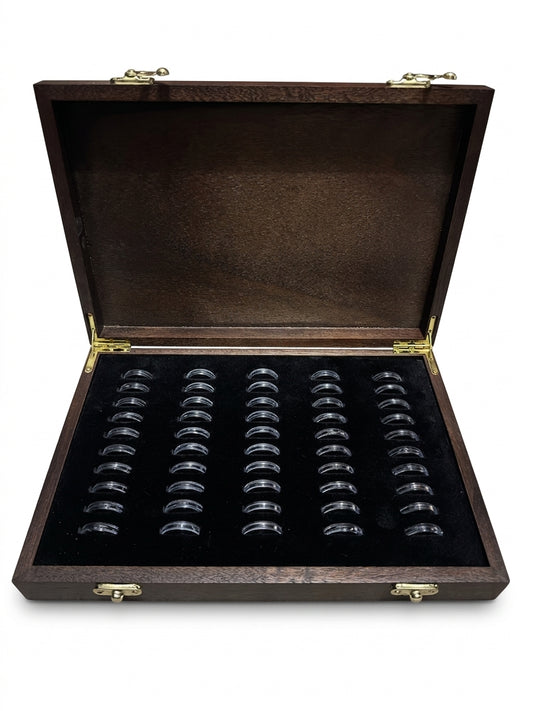
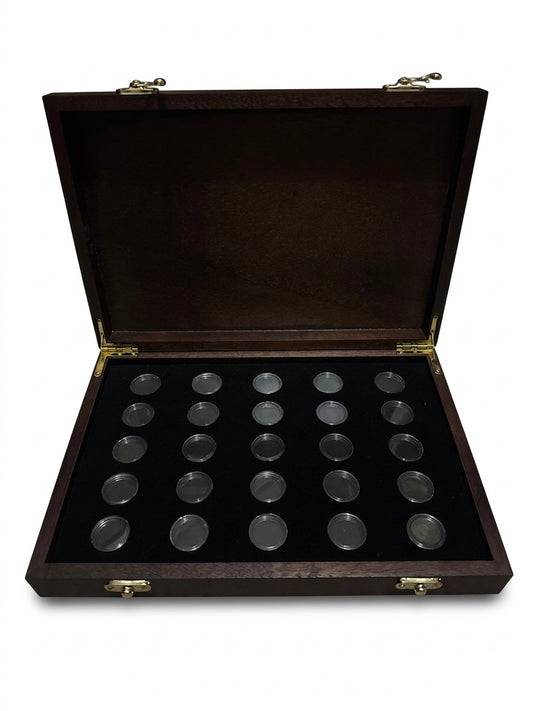
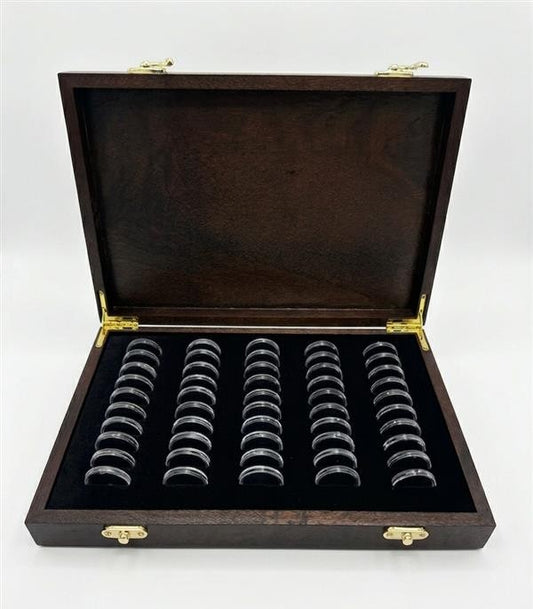
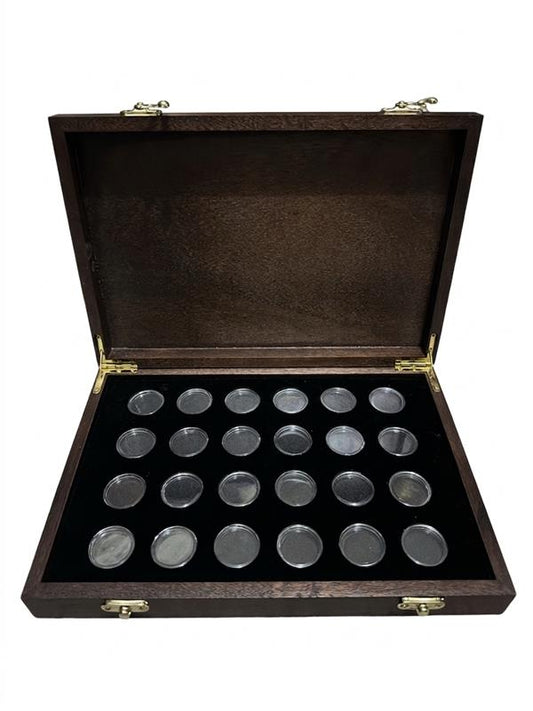
Individual capsules protect individual coins. But a collection is not a series of individual objects — it is a whole, and it deserves storage that treats it as such. A purpose-built display case serves several functions simultaneously: it holds capsules securely in position so they cannot contact each other, it provides a controlled microenvironment that limits humidity fluctuation, it blocks UV exposure, and it allows the collection to be seen and appreciated without requiring each coin to be individually handled.
The material of the case matters. Timber — particularly hardwoods with stable, low-moisture content — provides a natural buffer against humidity fluctuation and does not off-gas the reactive compounds found in many synthetic materials. A case finished with an inert satin coating rather than oil or wax treatments that continue to react over time is preferable for long-term archival use.
The foam recesses in which capsules sit should be cut precisely to the capsule diameter — loose fitting means movement, and movement means contact. A well-made foam insert holds each capsule firmly enough that the case can be lifted and tilted without any capsule shifting. This precision is not cosmetic. It is functional.
Environment — Where the Case Lives Matters
Even a correctly stored coin in the best available capsule inside a purpose-built case will deteriorate if the environment surrounding that case is hostile. Humidity above 55% is the threshold above which silver toning accelerates. Temperature fluctuations — not high temperatures per se, but the cycling between warm and cool — cause expansion and contraction that stresses capsule seals and can admit moisture.
The ideal storage environment for Australian decimal coins is a climate-controlled interior space — a study, a living room, a bedroom — where temperature remains relatively stable year-round and humidity is managed. Basements, garages, garden sheds, and bathroom cabinetry are all environments that present unnecessary risk.
For collectors in particularly humid climates — coastal Queensland, tropical Northern Territory — silica gel desiccant packets in the storage area can provide an additional buffer. These should be replaced or regenerated annually and are not a substitute for appropriate placement, but they add a meaningful layer of protection in environments where humidity control is difficult.
The Question of Cleaning — An Unambiguous Answer
The numismatic community is unusually unified on this point: do not clean coins. Not with water, not with gentle soap, not with silver polish, not with a soft cloth. The act of cleaning — any cleaning — removes microscopic layers of metal from the coin's surface and creates the fine surface abrasion known as "cleaning" or "polishing" that is immediately apparent under magnification and permanently reduces the coin's grade and value.
A toned coin — one that has developed the natural patina of age — is not a damaged coin. Natural toning, provided it is even and undisturbed, is considered by most experienced collectors to be desirable. It is evidence of the coin's age and an indicator that it has not been interfered with. "Original surfaces" is a phrase used by grading services to distinguish coins that have never been cleaned from those that have — and the premium for original surfaces is significant.
If a coin has been cared for from the moment it was acquired — handled correctly, stored in appropriate capsules, kept in a stable environment — cleaning will never be necessary. Prevention is the only strategy. There is no remediation.
Handcrafted timber display cases precision-fitted for Australian decimal coin capsules — protecting your collection while keeping every coin visible.
Browse The Collection