The Timber
On the material at the heart of every Thomas Anne case — and why it was chosen
Before a Thomas Anne case is a case, it is a board. Before it is a board, it is a tree — one that grew slowly, in a specific place, over years that left their record in the grain. When we talk about hand-selected timber, we are talking about the moment someone looks at that record and decides whether it is worthy of what will be asked of it.
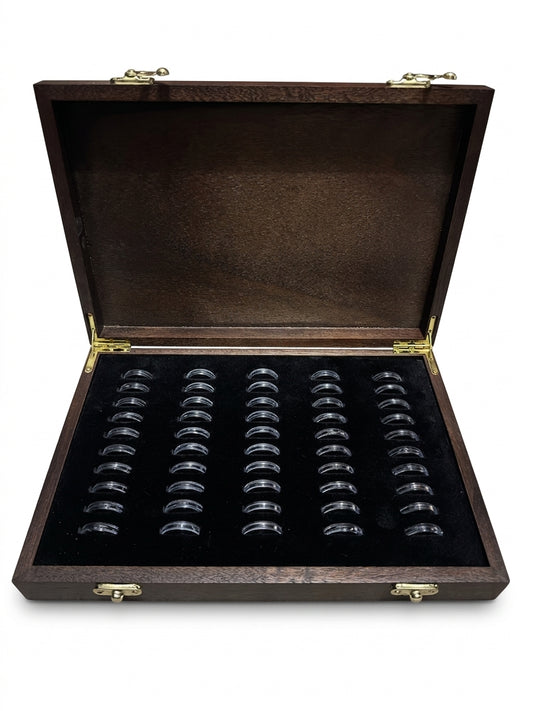
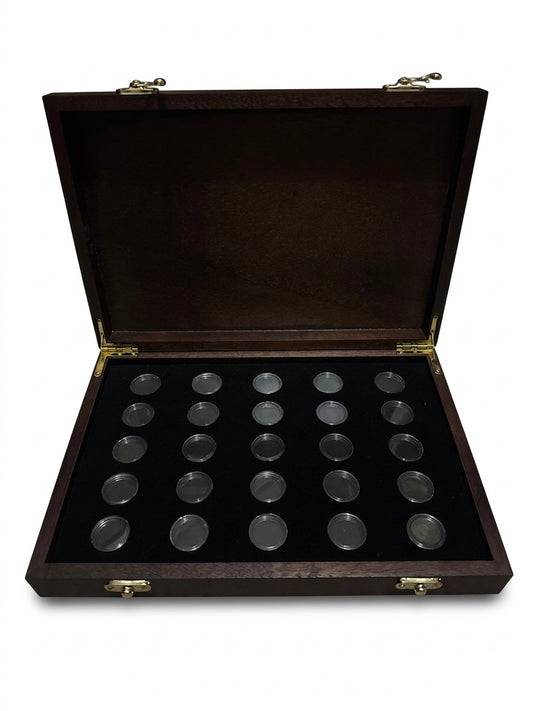
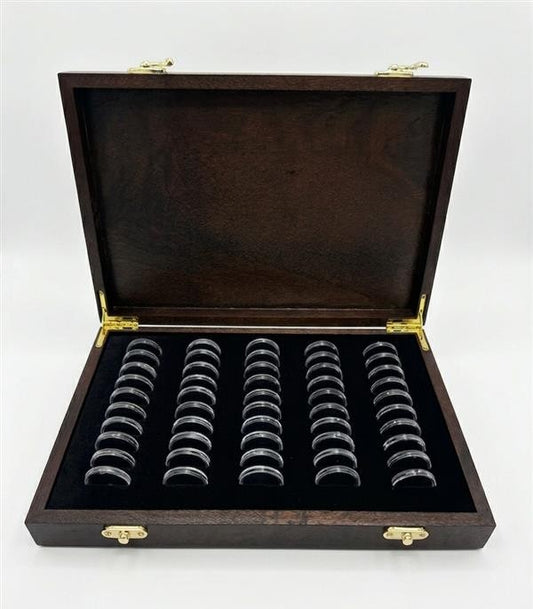
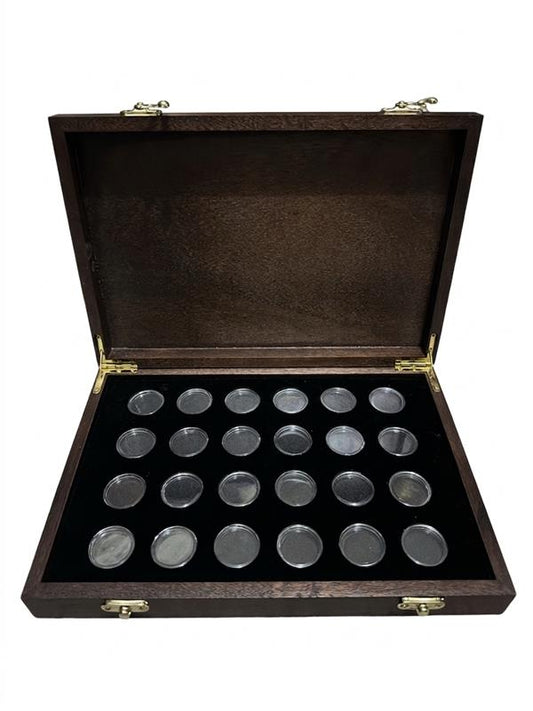
We use Mahogany Family Hardwood. Not because it is the most prestigious timber on earth, but because it is the right timber for this object — and because the right material, understood properly, is more honest than an impressive one chosen for its name.
What the Timber Does
A display case for coins must do several things simultaneously. It must be structurally stable — the joints must hold under the weight of a full coin load without creeping. It must be dimensionally consistent — a case that warps in humidity will not close cleanly or hold its foam inserts true. It must take a finish that is beautiful to look at and resistant to the handling a case receives over years of regular use. And it must age well — not merely resist deterioration, but develop character as it is used.
Mahogany Family Hardwood does all of this. Its grain runs in long, relatively straight lines that machine cleanly and finish to a deep, consistent lustre. It has the density to hold hardware — the hinges, the clasps, the corner details — without the fastener points compressing or loosening with use. It responds to satin finishes in a way that enhances rather than obscures the natural character of the wood beneath.
It also engraves. The paint ablation technique we use on our engraved cases — where the laser vaporises the painted finish to reveal the raw timber beneath — produces results on this wood that would not be possible on many alternatives. The warm amber and pink tones that emerge through the finish, the way the grain intersects with the engraved lines to create a result that is never quite identical twice — these are qualities specific to this material and this technique in combination.
"We do not choose timber because it looks good in a photograph. We choose it because it will still be worthy of the collection it holds in thirty years."
Bradley Thomas — Thomas Anne CollectiblesHand Selection — What It Actually Means
Hand selection is not a marketing phrase. It describes a specific act — someone picking up a board, turning it over, looking at the end grain, bending down to sight along its face for wind, and deciding whether it meets the standard required. This happens before any cutting takes place.
What we are looking for: grain that runs parallel to the face without wild deviation. Density that is consistent across the board rather than showing soft patches. Freedom from checks — the small surface splits that develop as timber dries — in the areas that will become the visible faces of the case. And a natural colour and character that will reward the finish rather than fight it.
Boards that do not meet this standard are not used. This is not waste — it is the cost of making something worth making. It is also part of why we work made to order rather than from stock. A case built from timber that was selected with this care will behave differently over the years from one that was not. The joints will remain tight. The finish will wear evenly. The case will continue to close with the same satisfying resistance it had on the day it was made.
The Grain as Identity
No two boards are the same. This is a fact of working with a natural material, and it is one we lean into rather than try to engineer away. The grain of the timber in your case ran its own course through the tree it came from. It caught the light in a particular way on the day it was cut. It will catch the light in that same way on the day your collection is complete.
This is the quality that manufactured materials cannot replicate — not because they are inferior, but because they are uniform. A Thomas Anne case is not uniform. It is particular. It is the specific piece of timber from which it was made, and that will always be true of it.
Handcrafted timber display cases built for the Australian decimal series — protecting your collection while keeping every coin visible.
Browse The Collection