Australian Commemorative Coins
A collector's guide to the coins that mark Australia's history — from 1970 to today
Since 1927, Australia has marked its most significant moments in metal. Coronations and federations, wars and jubilees, explorers and athletes — each occasion recorded in coin, struck at the Royal Australian Mint and released into the hands of a nation that has proven, time and again, that it pays attention to what its currency carries.
Australian commemorative coins span nearly a century of minting history and represent one of the richest collecting fields in the Southern Hemisphere. This guide introduces the series that matter most — and explains what makes each one worth pursuing.
What Is a Commemorative Coin?
A commemorative coin is a legal tender coin issued to mark a specific event, person, or occasion. Unlike standard circulation coins — which carry the same design year after year — commemoratives feature unique reverse designs created specifically for the occasion being honoured.
Australian commemoratives fall into two broad categories. Circulating commemoratives are released into general use alongside standard coinage — they appear in change, pass through hands, and often disappear into drawers and piggy banks before collectors realise they exist. Non-circulating commemoratives are struck specifically for collectors, often in proof or uncirculated finish, and sold directly through the Royal Australian Mint and authorised dealers.
For most collectors, circulating commemoratives represent the most accessible and rewarding entry point — coins that reward attention, patience, and the habit of checking your change.
Where It Began — The 1927 Canberra Florin
Australia's first commemorative coin was not a decimal issue. The 1927 Canberra Florin was struck to mark the opening of the new Parliament House in Canberra — the first purpose-built parliamentary building for the young federation. Designed with Old Parliament House on the reverse, only 400 proof examples and a limited circulation run were produced.
A proof example sold at auction in 2007 for $30,000. It remains one of the most significant pre-decimal Australian coins and the starting point of what would become a rich commemorative tradition.
The Decimal Era — 1970 Captain Cook Fifty Cent
The first commemorative coin of Australia's decimal era arrived in 1970 — four years after decimalisation — to mark the bicentenary of Lieutenant James Cook's navigation of Australia's east coast. Designed by Stuart Devlin, the reverse features Cook's portrait set against a map of Australia tracing his 1770 voyage. It was the first time the standard fifty cent reverse had been replaced since the series began.
With a mintage of over 16 million, the 1970 Captain Cook fifty cent is not scarce in circulated grades — but uncirculated examples from the original red presentation case are genuinely collectible and form the foundation of any commemorative fifty cent collection.
It also established a tradition that has continued ever since: the fifty cent, by virtue of its large dodecagonal canvas, became Australia's preferred denomination for commemorative design. More commemorative fifty cent coins have been issued than any other denomination.
The Commemorative Fifty Cent — Notable Issues
Across six decades, the commemorative fifty cent series has marked some of Australia's most significant national moments. A selection of the most collectible issues:
Marking Queen Elizabeth II's 25th year on the throne. Features a crown motif and was Australia's first commemorative fifty cent since 1970. A reliable staple of any commemorative collection.
Issued to commemorate the marriage of Prince Charles and Lady Diana Spencer. One of the most widely collected commemorative fifty cents — and in retrospect, one of the most historically resonant.
Marking 200 years since the arrival of the First Fleet in 1788. Issued during one of Australia's largest national celebrations and represents a pivotal moment in the nation's sense of identity.
Honouring Sir Edward "Weary" Dunlop — surgeon, prisoner of war, and one of Australia's most beloved figures. Among the most emotionally significant commemorative issues of the decade.
A ten-coin state and territory series marking 100 years of Federation. Ambitious in scope — each coin a different design representing one of the nine jurisdictions. A complete set is a genuine collecting achievement.
A multi-coin programme marking 100 years since Gallipoli. Included coloured and standard issues across multiple denominations. Among the most emotionally resonant modern commemorative series.
The Coloured $2 Revolution — 2012 to Today
No development in modern Australian commemorative coinage has captured public imagination more completely than the introduction of coloured $2 coins in 2012. Australia became only the second country in the world — after Canada — to issue coloured coins for general circulation. The effect on the collecting community was immediate and lasting.
The 2012 Red Poppy — the first coloured $2 — was released to mark Remembrance Day with a mintage of just 503,000 against a typical annual run of 28 million. Finding one with its colour intact became a national pastime. It now trades at $200 to $400 for well-preserved examples.
The 2013 Purple Coronation followed — marking 60 years since Queen Elizabeth II's coronation — with a mintage of 995,000 and improved colour technology that made it more durable in circulation. The "Coro," as collectors know it, now fetches $30 to $75 in circulated grades with the 'C' mintmark edition commanding $400 to $500.
The coloured $2 programme has continued annually since, with each release generating the same excitement: a new design released quietly into circulation, millions of Australians checking their change, and a collecting community that has grown substantially around the denomination.
The Commemorative Dollar — A Series Worth Following
The $1 coin entered the commemorative programme in 1986 and has since become one of the most consistently interesting series in Australian numismatics. The standard Mob of Roos reverse — introduced in 1984 — has been replaced regularly with designs marking significant occasions.
Notable issues include the 2000 Sydney Olympics series — a landmark moment for Australian commemoratives, featuring multiple designs released into circulation during the Games — and the 2016 Decimal Currency 50th Anniversary issue, which uniquely placed the commemorative design on the obverse rather than the reverse for the only time in Australian decimal history.
For collectors building a complete run of the $1 series, the commemorative years represent both the most visually varied and the most historically significant pieces in the set.
The End of an Era — Queen Elizabeth II Commemoratives
The passing of Queen Elizabeth II in September 2022 created an immediate and sustained surge in demand for all Australian coins bearing her portrait — but particularly for commemorative issues that marked milestones in her reign. The Silver Jubilee fifty cent, the Golden Jubilee dollar, the Diamond Jubilee issues — all saw meaningful price increases as collectors recognised their dual significance as both commemoratives and historical records of a seventy-year reign.
The Royal Australian Mint issued a memorial $1 coin in 2022 bearing a special effigy, followed by the transition to King Charles III's portrait across all denominations from 2023 onwards. The final Elizabeth II coins now carry a historical weight they never possessed during her lifetime.
For the collector building a commemorative collection, the Elizabeth II era represents six decades of Australian history told in coin — from the optimism of decimalisation in 1966 to the quiet solemnity of a nation marking the end of an extraordinary reign.
How to Approach a Commemorative Collection
Choose a focus. The breadth of Australian commemorative coinage is vast. The most satisfying collections are built around a denomination — a complete fifty cent run, for instance — or a theme: ANZAC issues, royal commemoratives, Federation coins. A focused collection tells a coherent story.
Check your change. Circulating commemoratives still appear in everyday use. The habit of checking the date and reverse of every fifty cent and two dollar coin that passes through your hands costs nothing and occasionally produces genuine finds.
Buy presentation cases where possible. Many commemorative issues were sold in original RAM presentation cards or folders. An example in its original packaging commands a premium and preserves the coin in the condition it was issued.
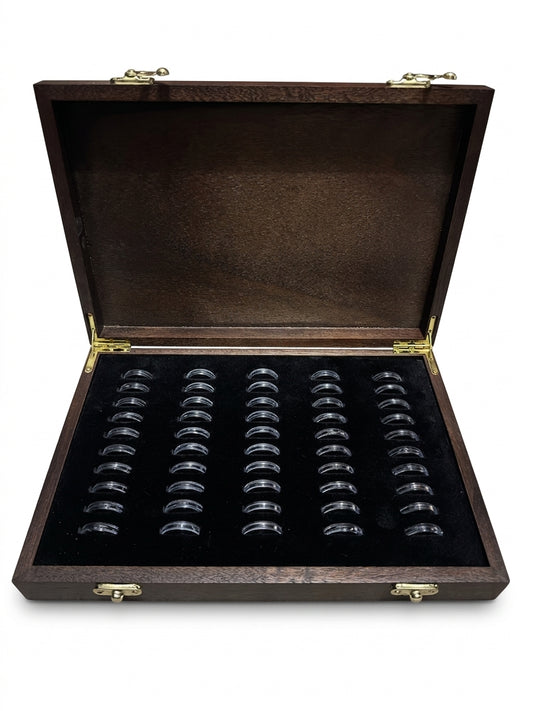
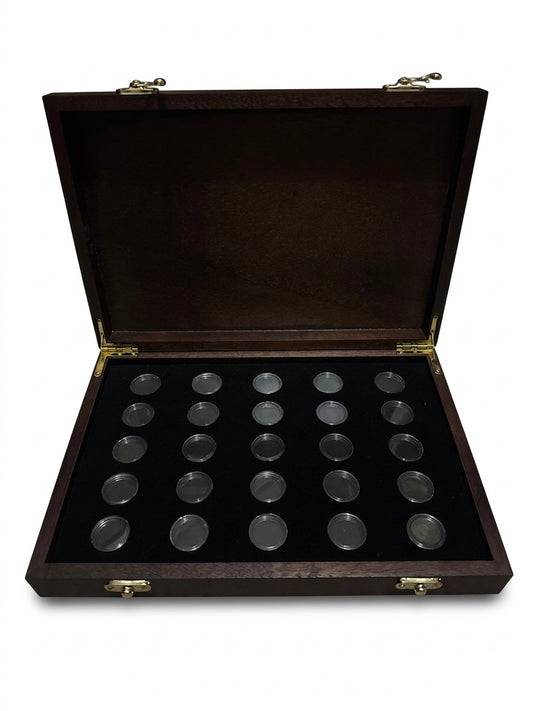
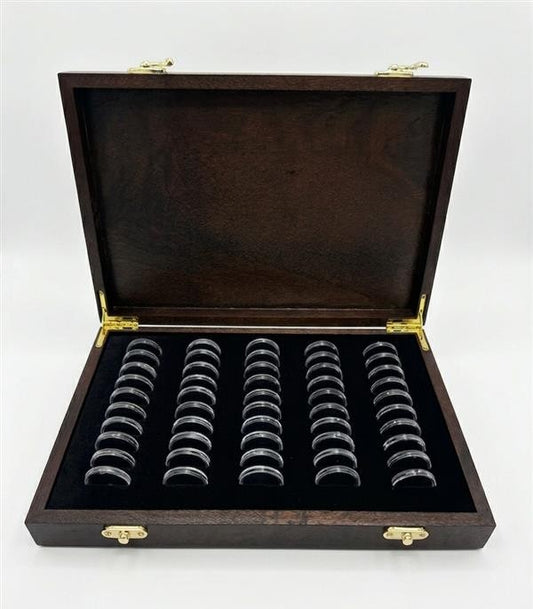
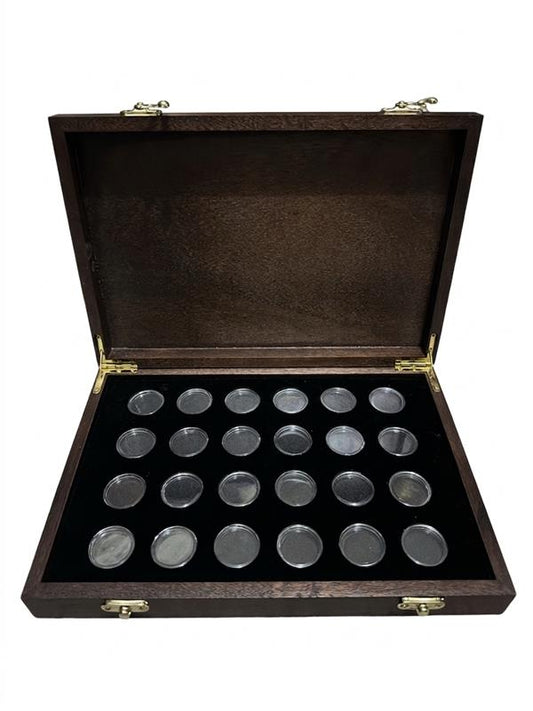
Store properly. Commemorative coins — particularly coloured issues — are sensitive to humidity, light, and physical contact. Purpose-built display cases with precision-cut capsule recesses protect both the coin and its colour from the environmental factors that degrade them over time.
Every commemorative coin is a decision made by a nation about what matters enough to mark in metal. A collection of commemoratives is a collection of those decisions — the moments a country chose to remember itself.
Handcrafted mahogany display cases built for Australian decimal and commemorative coins. Precision-cut recesses for coin capsules across every denomination — protecting your collection while keeping every piece visible.
Including cases designed specifically for the $2 and 50 cent series.
Browse The Collection