Stuart Devlin and the Decimal Series
The goldsmith who gave Australia's coins their character — and why his designs endure sixty years on
Every time an Australian handles a five cent coin and sees the echidna, or turns over a ten cent to find the lyrebird in full display, they are encountering the work of a single man. Stuart Devlin — Australian-born, London-trained, eventually goldsmith to the Queen — designed the reverse faces of six of Australia's seven original decimal coins. His work has been in continuous circulation since Decimal Day, 14 February 1966.
That is one of the longest uninterrupted runs in the history of circulating currency design anywhere in the world. And most Australians have never heard his name.
The Commission — A Young Goldsmith and a Nation's Identity
In 1963, the Australian government held an international design competition for the reverse faces of the new decimal coinage series. Stuart Devlin — then 29 years old, recently returned from a year in the United States on a Winston Churchill Fellowship, and not yet the celebrated goldsmith he would become — entered and won.
The brief was demanding: to create designs that were distinctly Australian, technically suitable for mass production, and aesthetically coherent as a series. Devlin's response was to turn to Australian wildlife — the animals that exist nowhere else on earth — and render them with a naturalistic precision that had rarely been seen in circulating coin design.
His winning designs were selected from 173 entries by 36 artists. The judging panel, which included representatives from the Royal Australian Mint and the Decimal Currency Board, was unanimous. Devlin was awarded the commission for all seven denominations.
The Designs — Seven Animals, One Vision
Devlin's animal studies for the decimal series are remarkable for their restraint and accuracy. Each design uses the limited relief available in circulating coin production to maximum effect — suggesting depth, texture, and movement within a composition that must survive millions of impressions and years of handling.
The feathertail glider — Australia's smallest gliding mammal, rendered mid-glide with extraordinary delicacy.
The frilled-neck lizard — neck frill extended, caught in a moment of territorial display.
The echidna — one of only two monotremes on earth, shown with its characteristic quill texture and searching snout.
The lyrebird in full display — tail feathers fanned, arguably the most technically accomplished of Devlin's decimal designs.
The platypus — swimming, bill forward, its improbable anatomy rendered with calm authority.
The Australian coat of arms — kangaroo and emu flanking the shield, rendered with heraldic precision on both the original round coin and the subsequent dodecagonal design.
The one denomination not designed by Devlin was the one dollar coin, introduced in 1984 — two decades after his original commission. That coin, the famous Mob of Roos, was also designed by Devlin, bringing the full circulating decimal series under his authorship. The Mob of Six Roos, released in 2026 to mark the 60th anniversary of decimalisation, adds a sixth kangaroo to his original composition — a quiet tribute to the designer whose work has outlasted almost every assumption made about how long coinage designs endure.
"I wanted the animals to look alive. Not illustrated, not decorative — alive. These were creatures that existed nowhere else in the world."
Stuart Devlin OBE CMGAfter the Coins — A Career in Gold
The decimal coin commission launched Devlin's career in ways he could not have anticipated. He moved to London in 1965, established a studio in Clerkenwell, and within a decade had become one of Britain's most celebrated goldsmiths. In 1982, he was appointed Goldsmith and Jeweller to Queen Elizabeth II — the same Queen whose portrait graced the obverse of every coin he had designed.
He was appointed OBE in 1980 and CMG in 1996. His work in gold and silver — ceremonial pieces, presentation objects, jewellery for royal commissions — is held in collections around the world. He died in 2018 at the age of 85.
His legacy in Australia is carried in the pockets of every Australian every day. The feathertail glider, the lyrebird, the mob of roos — they belong to the national visual vocabulary in a way that few designed objects ever achieve. They are, simply, what Australian coins look like.
Collecting Devlin — The Complete Series
For the collector, building a set of Devlin's decimal designs in uncirculated condition is one of the most satisfying projects in Australian numismatics. The 1966 date for each denomination represents the original vision — the designs as they were first struck, on coins that have never been spent. Finding all seven denominations from 1966 in genuine uncirculated condition requires patience and some expense, particularly for the round fifty cent and the one cent.
To hold a complete set of Devlin's 1966 decimal series in uncirculated condition is to hold the moment a nation chose its visual identity — preserved exactly as it was on the day it was made.
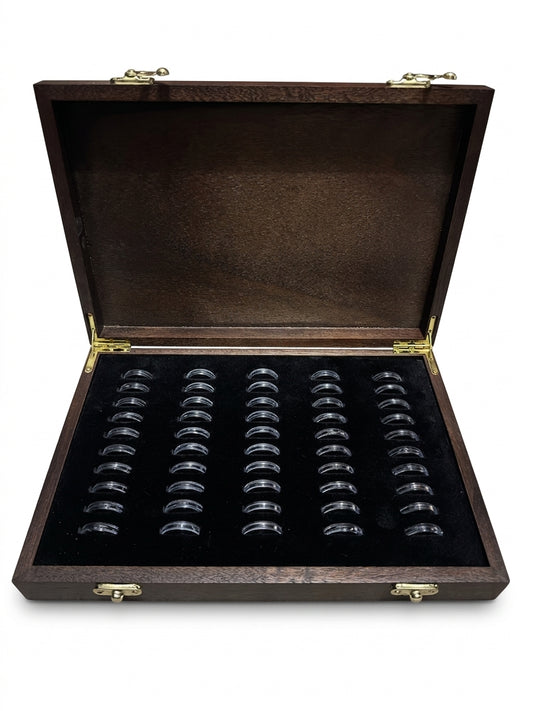
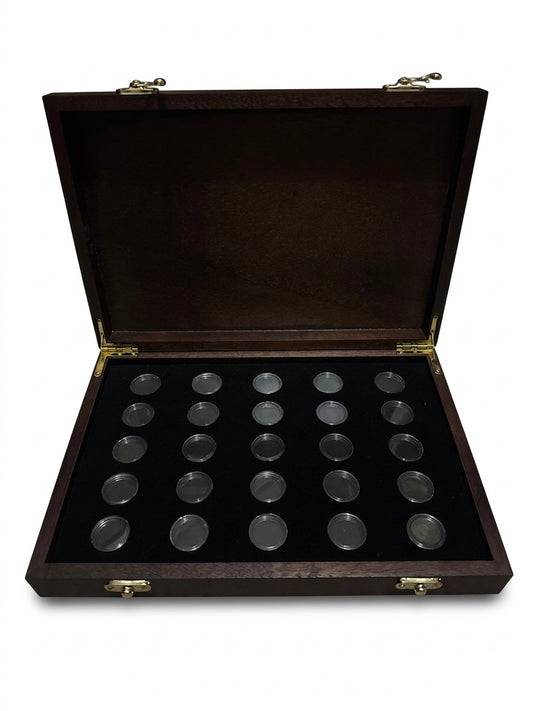
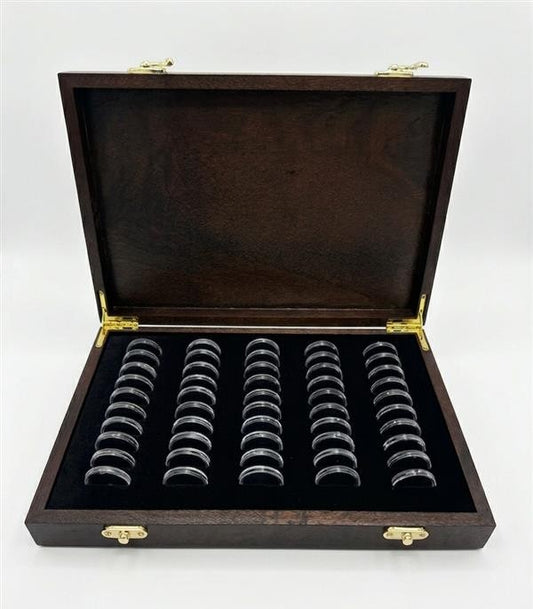
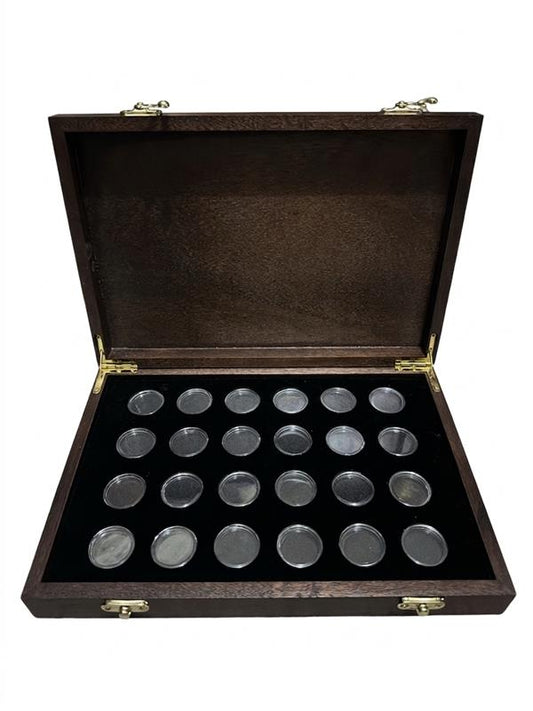
Handcrafted timber display cases built for the Australian decimal series — protecting your collection while keeping every coin visible.
Browse The Collection