The Annual Proof Set
A year-by-year guide to the RAM proof set — notable years, gap years, and what makes certain sets significantly more valuable
The Royal Australian Mint has produced an annual proof set almost continuously since 1966 — the year of decimalisation. Each set contains proof-quality strikes of the circulating denominations for that year, individually encapsulated and presented in a purpose-built case with a certificate of authenticity. For the collector who wants one example of every denomination in the finest possible quality for each year, the annual proof set is the most efficient path to a complete collection.
But the proof set series is not uniform. Mintages vary significantly across years. Some years were not produced. Some sets contained denominations not available in circulating form. Understanding the series year by year is essential for the collector approaching it seriously.
The Most Significant Years
1966. The first decimal proof set. Contains proof strikes of all six original denominations — one cent through fifty cent — in the changeover compositions. The fifty cent is the round, 80% silver coin, making this the only proof set that includes a silver fifty cent in standard form. The 1966 proof set is the most historically significant in the series and, in original presentation with intact packaging, among the most sought.
1967–1968. Early sets in the series with relatively modest mintages by later standards. The two-cent pieces in proof from these years are of particular note given the denomination's subsequent retirement.
1972. No standard proof set was issued. A gap year in the series. For collectors assembling a complete run of proof sets, this year cannot be filled with an annual set — the options are limited to specialist issues from that period.
1984. First proof set to include the newly introduced dollar coin. The 1984 proof dollar carries the Machin portrait used only in this year — making this set a key acquisition for collectors of the dollar series by portrait.
1992. The proof set for the key date year. The 1992 proof dollar is considerably more accessible than the business strike equivalent — the proof set was produced in numbers sufficient to meet collector demand — but it remains a significant year in any proof set run and one of the more actively sought sets from the 1990s.
"The proof set series spans nearly six decades and contains the finest official strikes of every circulating denomination. For the collector who wants to hold the definitive version of each year's coinage, there is no better starting point."
The Collector's Journal — Thomas Anne CollectiblesComposition Changes
The compositions of the proof set denominations have changed over the history of the series. The most significant changes: the one and two cent pieces were retired after 1991 and do not appear in proof sets from 1992 onward. The fifty cent moved from the original 80% silver (1966 only in standard proof sets) to cupro-nickel dodecagonal from 1969. The compositions of the smaller denominations were adjusted in the 1990s as metal costs rose.
For the collector, these composition changes mean that proof sets from different eras are materially different objects. The 1966 set contains silver; the 1992 set contains no silver and no one or two cent pieces. Building a complete run captures all of these transitions in their original presentation.
Condition and Presentation
Proof sets should be acquired in their original presentation wherever possible — the RAM case, the certificate of authenticity intact and undetached, the encapsulation unopened. A proof set that has been removed from its original packaging is still a proof coin, but it has lost the context of its original issue. For the collector building a complete run, consistent condition across all sets — original, unhandled, in original packaging — is the standard worth maintaining from the beginning.
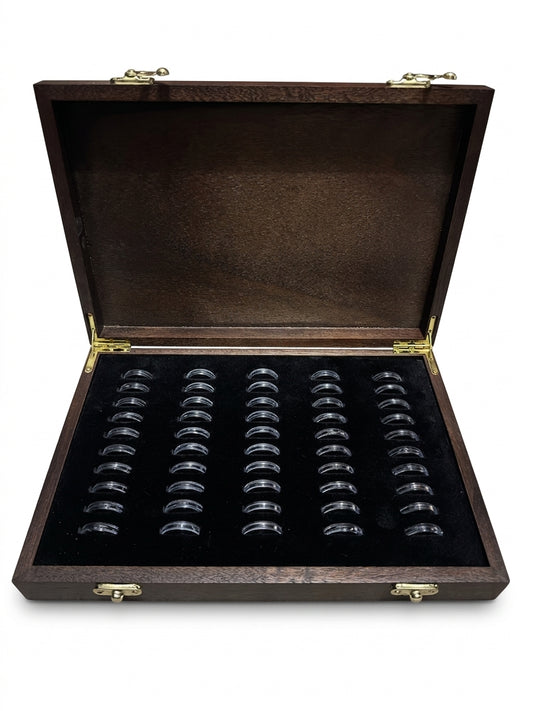
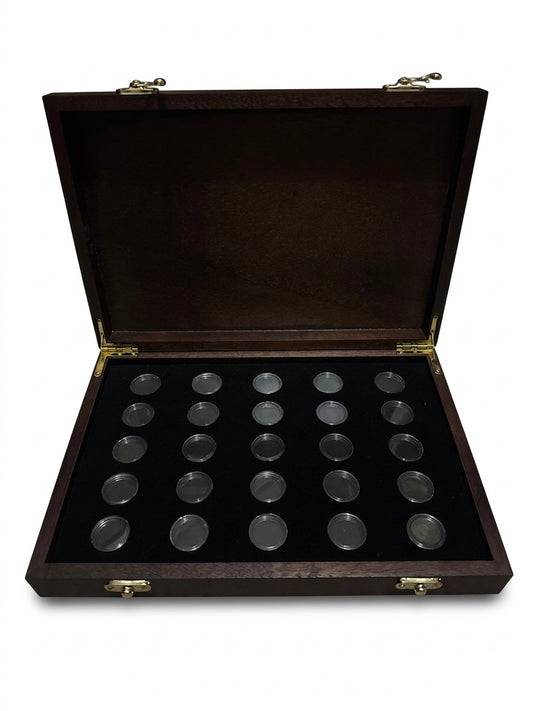
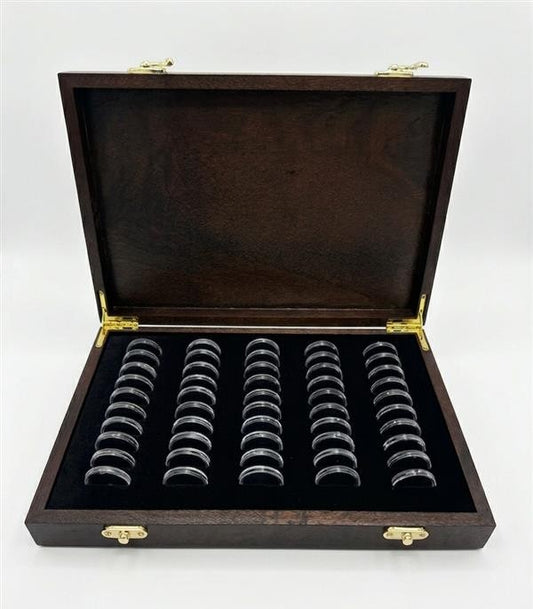
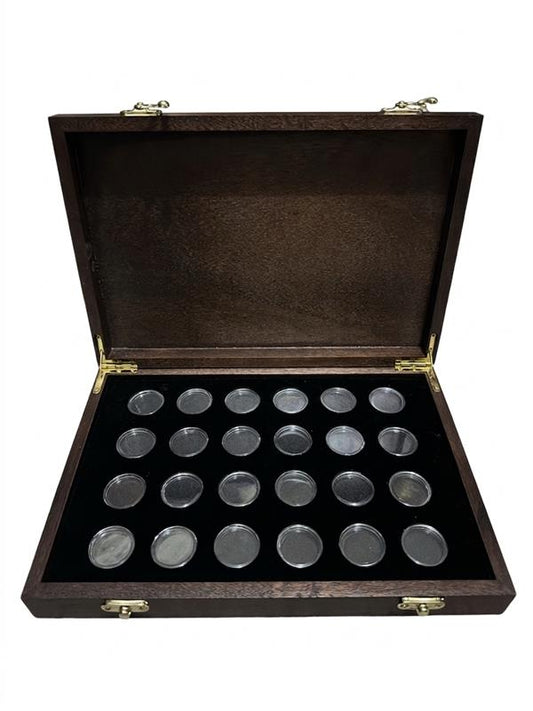
Handcrafted timber display cases purpose-built for the Australian decimal series — keeping every coin visible and every collection protected.
Browse The Collection