What Is a Proof Coin
A collector's guide to the most finely struck coins in Australian numismatics
The word "proof" is one of the most misunderstood in coin collecting. Non-collectors sometimes assume it refers to age, or rarity, or precious metal content. Experienced collectors know it refers to something more specific — and more remarkable: a standard of manufacture so exacting that the coin produced bears almost no resemblance, in appearance, to the version of itself that circulates through ordinary commerce.
A proof coin is not a type of coin. It is a method of production — and one that results in some of the most visually extraordinary objects in the entire numismatic world.
The Manufacturing Process — Precision at Every Stage
Proof coins begin with specially prepared blank planchets — the metal discs from which all coins are struck. Unlike circulation blanks, proof planchets are individually inspected, polished to a mirror finish, and handled with cotton gloves throughout the production process. A single fingerprint at this stage would compromise the final result.
The dies used for proof coins — the engraved steel tools that impress the design onto the metal — are also specially prepared. The fields (the flat background areas of the coin) are polished to a mirror finish, while the design elements are sandblasted or frosted to create a matte surface. This contrast between mirror fields and frosted relief is what produces the dramatic visual effect known as cameo — the defining quality of a fine proof coin.
Each proof coin is struck multiple times — typically two or three — at slower speeds and with greater pressure than circulation strikes. This multiple striking ensures complete die fill, capturing the finest detail in the design. The result is a coin whose surface detail exceeds what is physically possible in a single high-speed circulation strike.
Cameo — The Mark of a True Proof
The cameo effect — frosted design elements against mirror-polished fields — is the visual signature of a high-quality proof coin. When the coin is tilted in the light, the mirrored fields reflect the surroundings while the frosted portrait and reverse design remain sharp and matte, creating a three-dimensional effect of remarkable depth.
In grading terminology, proof coins with strong cameo contrast are designated as PF-CAM (Proof Cameo) or PF-DCAM (Proof Deep Cameo), with the latter representing the strongest possible contrast. A PF-70 DCAM — a perfect specimen with deep cameo contrast and no detectable flaws under 5x magnification — represents the absolute pinnacle of proof coin production.
It is worth noting that the cameo effect diminishes with each coin struck from a given die. The first coins off a freshly prepared proof die will exhibit the strongest cameo. As the die is used, the frosted elements gradually become polished by metal flow, and later strikes from the same die will show progressively less contrast. This makes early-die-state proof coins among the most prized examples of any issue.
"A proof coin is not simply a better-made version of a circulation coin. It is a different object — made under different conditions, for a different purpose, and with a different understanding of what a coin can be."
The Collector's Journal — Thomas Anne CollectiblesAustralian Proof Sets — A Brief History
The Royal Australian Mint has issued annual proof sets since 1966. The first proof set — containing all seven denominations of the new decimal series, struck in the same compositions as circulation coins — was issued in a limited quantity and has become one of the most sought-after items in the entire Australian proof series. Its rarity relative to later sets, combined with its historical significance as the inaugural decimal proof set, gives it a distinct place in the collecting hierarchy.
1968 is a notable gap year — no proof set was issued, making proof examples of that year's denominations extraordinarily rare for most denominations. This absence has significant consequences for collectors building a complete date run in proof, particularly for the one cent.
From the 1970s onward, the RAM expanded its proof programme to include thematic and commemorative issues — silver proofs, gold proofs, and coloured proof coins — alongside the annual base metal sets. This expansion means that for many years in the decimal series, multiple proof versions of the same denomination exist, each with different composition, mintage, and collector significance.
Handling, Storage, and the Proof Coin's Enemy
The mirror fields of a proof coin are extraordinarily vulnerable. A single contact mark — the faintest hairline scratch from even careful handling — will catch the light and detract from the coin's grade permanently. Proof coins should never be touched with bare hands, never slid across surfaces, and never removed from their capsules unless absolutely necessary for examination. For a full guide to protecting proof coins see our article on the care and storage of coins.
Cotton or nitrile gloves are essential for handling. The coin should be held by its edge only, never by the fields. Examination should be conducted under consistent, directional light — not overhead fluorescent — so that the cameo contrast can be properly assessed and any surface marks identified.
The proof coin represents the highest standard of what a mint is capable of producing. It deserves a level of care commensurate with that standard — and a home worthy of it.
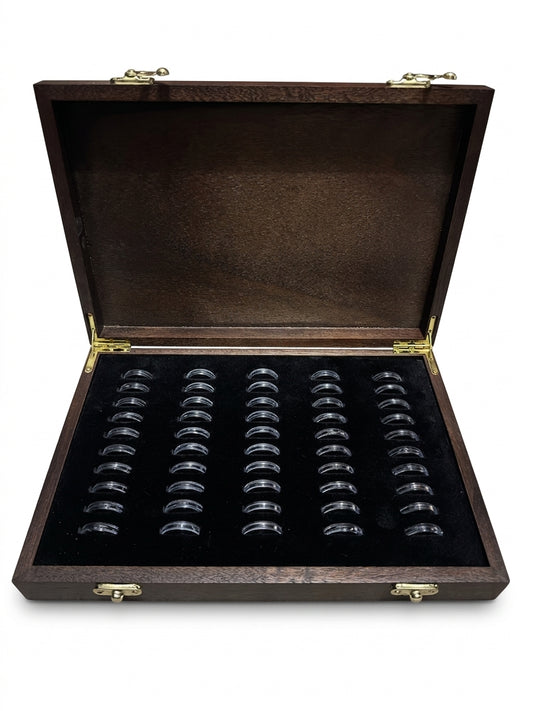
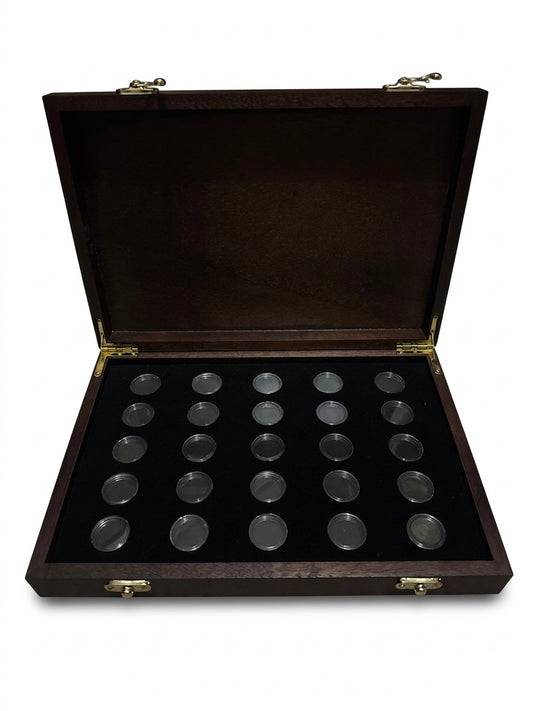
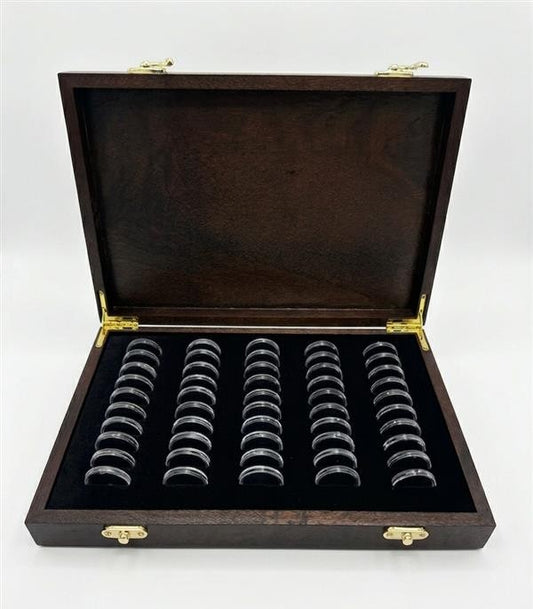
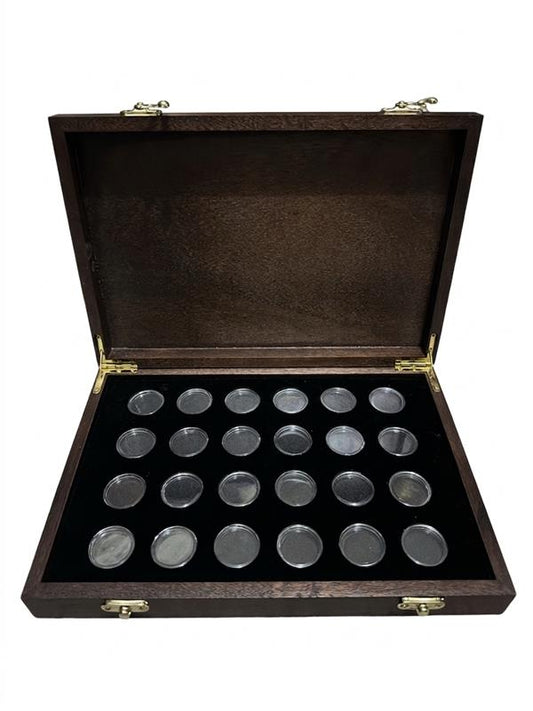
Handcrafted timber display cases built for the Australian decimal series — protecting your collection while keeping every coin visible.
Browse The Collection