Whispers of the Workshop
How a Thomas Anne case is made — from raw timber to the hands of the collector
A Thomas Anne case is not manufactured. It is made — by people who work with timber, who understand grain and finish and fit, and who know that the person receiving the case will open it for the first time and immediately understand whether the work was done properly or not.
The process from raw material to finished case involves six distinct stages. Each one matters. None of them can be rushed without the next one showing it.
Hand-selected Mahogany Family Hardwood is chosen for each case — evaluated for grain consistency, density, and the warmth it carries in a finished state. Not every board passes. The timber that becomes a Thomas Anne case is selected because it will hold a finish well and age gracefully — developing character rather than degrading. Plywood forms the base, providing structural stability that solid timber alone cannot.
The timber is sanded through progressively finer grits until the surface is ready to accept the finish evenly. Any imperfection in this stage shows in the final coat — there is no hiding poor preparation under a good finish. This is the stage that separates a case that looks right from a case that feels right when you run your hand across it.
The deep satin finish is applied in multiple thin coats, each allowed to cure fully before the next is laid down. Where laser engraving is specified, the engraving cuts through the finish to the raw timber beneath — exposing the natural colour and grain of the Mahogany Family Hardwood in contrast to the sealed surface. No two cases are identical at this stage. The grain beneath the finish is different on every plank.
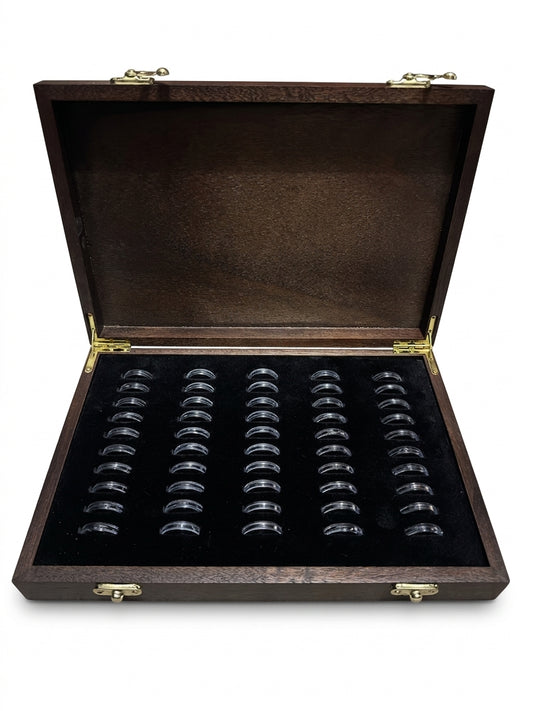
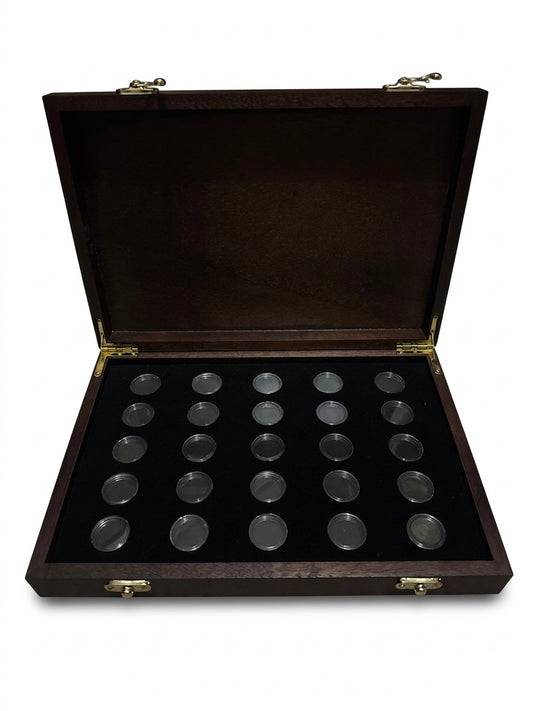
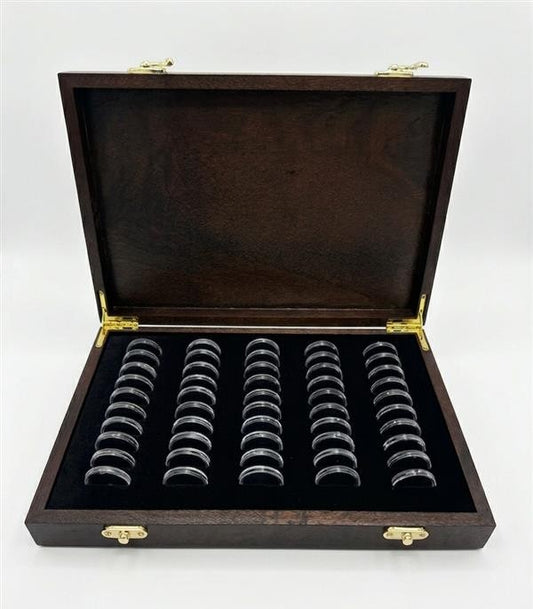
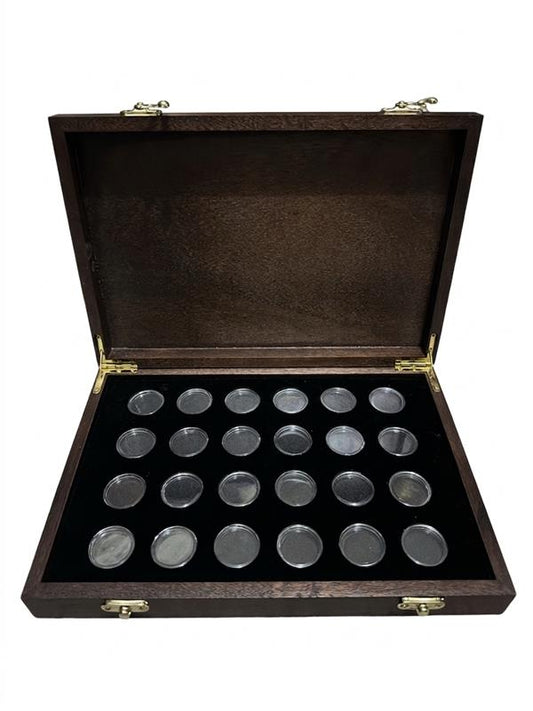
The finished components are assembled and the brass hardware — locks and hinges — is fitted. The hinges are set to open smoothly and hold their position. The locks are aligned to close cleanly without force. The foam insert is cut to the exact diameter required for the coin capsules of the denomination the case is designed for — not approximately, exactly. A recess that is even slightly oversized allows movement, and movement causes damage.
Every case is inspected before it leaves. The finish is examined for consistency. The hardware is tested. The foam recesses are checked. The question asked at this stage is the same question asked at every stage: would we accept this for our own collection? If the answer is no — for any reason — the case does not proceed. This is not a quality assurance process. It is the only standard we know how to work to.
The case is packed with the introduction letter, the coin capsules, the microfibre cloth, and the cotton gloves. The letter is signed by hand by Bradley and Cristy-Anne. The package is sealed and dispatched. From this point, the case belongs to the collector — and the work of keeping begins.
"From raw timber to the hands of the collector — every stage is intentional, every decision made by someone who would keep this case themselves."
Bradley Thomas & Cristy-Anne — Thomas Anne CollectiblesHandcrafted timber display cases built for the Australian decimal series — protecting your collection while keeping every coin visible.
Browse The Collection